
 | |  | |  | |  | |  | |  | |  |


 |
| |
 |
| |
 |
| |
 |
| |
 |
| |
 |
| |
 |
| |
 |
| Health & Medical Village: 健康醫藥村: 035 |
| Fighting Cancer with Pineapple received from Flora Jeng, Rose Cheung |
One molecule, known as CCS, blocks a
protein called Ras, which is defective in
approximately 30 percent of all cancers.
The other, called CCZ, stimulates the
body's own immune system to target and
destroy cancer cells.
Researchers discovered these two
molecules work simultaneously to block
the growth of a broad range of tumor
cells including breast, lung, colon, ovarian
and melanoma.
And while CCS and CCZ are protease
enzymes (usually associated with
breaking down proteins, as in the
digestive process), the above findings
distinguish the molecules as a new way
of treating disease and potentially a
whole new class of anti-cancer agents.
What's more, bromelain, a rich source of
enzymes, has also been found to
modulate immunological responses and
has been proposed to be of clinical use.
BBC News July 22, 2005
protein called Ras, which is defective in
approximately 30 percent of all cancers.
The other, called CCZ, stimulates the
body's own immune system to target and
destroy cancer cells.
Researchers discovered these two
molecules work simultaneously to block
the growth of a broad range of tumor
cells including breast, lung, colon, ovarian
and melanoma.
And while CCS and CCZ are protease
enzymes (usually associated with
breaking down proteins, as in the
digestive process), the above findings
distinguish the molecules as a new way
of treating disease and potentially a
whole new class of anti-cancer agents.
What's more, bromelain, a rich source of
enzymes, has also been found to
modulate immunological responses and
has been proposed to be of clinical use.
BBC News July 22, 2005
It is hoped the research, carried out by Queensland Institute of Medical Research, could
lead to new anti-cancer drugs.
The origin of many anti-cancer drugs can be found in nature
Dr Julie Sharp
The extract studied by the scientists, bromelain, is a rich source of enzymes and is widely
used as a meat tenderiser, to clarify beer and tan leather hides.
The Queensland team discovered that the extract also had pharmacological properties and
could activate specific immune cells while, simultaneously, blocking the immune function
of other cells.
Lead researcher Dr Tracey Mynott said: "We suspected that different components of the
crude mixture might be responsible for bromelain's biological effects.
"In searching for these components, we discovered the CCS and CCZ proteins and found
that they could block growth of a broad range of tumour cells, including breast, lung, colon,
ovarian and melanoma."
New action
Both CCS and CCZ are protease enzymes, more usually associated with breaking down
proteins, as in the digestive process.
Dr Mynott said it was the first time this class of enzymes had been shown to have a specific
effect on the immune system.
"The way CCS and CCZ work is different to any other drug in clinical use today.
"Therefore, CCS and CCZ will represent a totally new way of treating disease and potentially
a whole new class of anti-cancer agent."
Dr Julie Sharp, at Cancer Research UK, said: "The origin of many anti-cancer drugs can be
found in nature.
"However, it's early days for this research and the real test will be to see if the effects seen
in the lab can be reproduced successfully in patients."
lead to new anti-cancer drugs.
The origin of many anti-cancer drugs can be found in nature
Dr Julie Sharp
The extract studied by the scientists, bromelain, is a rich source of enzymes and is widely
used as a meat tenderiser, to clarify beer and tan leather hides.
The Queensland team discovered that the extract also had pharmacological properties and
could activate specific immune cells while, simultaneously, blocking the immune function
of other cells.
Lead researcher Dr Tracey Mynott said: "We suspected that different components of the
crude mixture might be responsible for bromelain's biological effects.
"In searching for these components, we discovered the CCS and CCZ proteins and found
that they could block growth of a broad range of tumour cells, including breast, lung, colon,
ovarian and melanoma."
New action
Both CCS and CCZ are protease enzymes, more usually associated with breaking down
proteins, as in the digestive process.
Dr Mynott said it was the first time this class of enzymes had been shown to have a specific
effect on the immune system.
"The way CCS and CCZ work is different to any other drug in clinical use today.
"Therefore, CCS and CCZ will represent a totally new way of treating disease and potentially
a whole new class of anti-cancer agent."
Dr Julie Sharp, at Cancer Research UK, said: "The origin of many anti-cancer drugs can be
found in nature.
"However, it's early days for this research and the real test will be to see if the effects seen
in the lab can be reproduced successfully in patients."
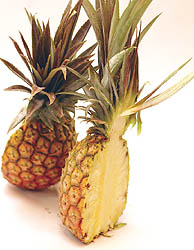
Fighting Cancer with Pineapple
According to the National Cancer
Institute, cancer has now surpassed
cardiac disease as the largest killer in the
United States. The incidence of cancer
increases with age, with approximately
80 percent of cancers occurring in people
over the age of 55.
However, according to researchers at the
Queensland Institute of Medical
Research, preventing cancer may be as
simple as eating pineapple.
Pineapple Fights Cancer Growth
While analyzing bromelain, an extract of
crushed pineapple stems, researchers
found that two molecules isolated from
the extract showed promise in fighting
cancer growth:
According to the National Cancer
Institute, cancer has now surpassed
cardiac disease as the largest killer in the
United States. The incidence of cancer
increases with age, with approximately
80 percent of cancers occurring in people
over the age of 55.
However, according to researchers at the
Queensland Institute of Medical
Research, preventing cancer may be as
simple as eating pineapple.
Pineapple Fights Cancer Growth
While analyzing bromelain, an extract of
crushed pineapple stems, researchers
found that two molecules isolated from
the extract showed promise in fighting
cancer growth:
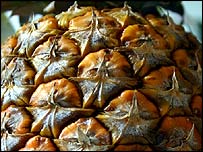
| Extract contains bioactive chemicals |
Two molecules isolated from an extract
of crushed pineapple stems have
shown promise in fighting cancer
growth.
One molecule called CCS blocks a
protein called Ras, which is defective in
approximately 30% of all cancers.
The other, called CCZ, stimulates the
body's own immune system to target
and kill cancer cells.
of crushed pineapple stems have
shown promise in fighting cancer
growth.
One molecule called CCS blocks a
protein called Ras, which is defective in
approximately 30% of all cancers.
The other, called CCZ, stimulates the
body's own immune system to target
and kill cancer cells.