----- Original Message -----
From: Betty Waung
To: Friends
Sent: Wednesday, January 16, 2008 7:58 AM
Subject: Fwd: Japanese Movie "Fudeko & her Angel's piano" information
Dear friends,
Can you support this event? Count our blessings everyday.
love,
Betty
Maria Sheehan <mfongsheehan@gmail.com> wrote:
Date: Wed, 16 Jan 2008 07:28:27 -0800
From: "Maria Sheehan" <mfongsheehan@gmail.com>
Subject: Fwd: Japanese Movie "Fudeko & her Angel's piano" information
I am definitely going. Hope you can join us.
---------- Forwarded message ----------
From: hiromi ashmore <hiromichan@cox.net>
Date: 2008/1/15
Subject: Japanese Movie "Fudeko & her Angel's piano" information
To: "Hiromi Ashmore (E-mail)" <hiromichan@cox.net>
Dear Wonderful teachers and friends,
My name is Hiromi Ashmore, my daughter Elena is 20 years old and has Down
Syndrome. She is now at Transition to Independent program at Palos Verdes.
In mid 2006, as I am a member of Down Syndrome Association of Japan,
I got to know this film "Fudeko & the Angel's piano". The story is about Fudeko
who dedicated her life for people with disabilities with her husband who
established the first facility for people with disabilities 100 years ago in Japan.
I really wanted people in LA have a chance to see this heartwarming movie,
so I initiated to bring it over here in 2007.
We had a first screening in November 2007 at Little Tokyo and made a great
success. Because of popular demand from South Bay and Irvine area, we will be
showing as above schedule(please look at the attachment)
This screening is benefit screening for the Switzer Learning center.
This is the inspiring true story about Fudeko who had a daughter with intellectual
disability in Japan a century ago. She dedicated her life for people with
developmental disabilities until she died at 83 years old. It creates extra
interests that many children with developmental disabilities were cast in this film
amongst very popular actors.
The director & producer of this film, Hisako Yamada is 74 years old and she has
a 43 years old daughter with severe intellectual disabilities. Through this movie
she hopes the audience will gain understanding and love for these special
children. She wishes to help create a society in which people recognize the
importance of each human being regardless of one's disability.
Could you please forward this as many people as you can, So far we only sold 20
tickets out of 400, we need to sell 300 at least so that we can make donation to
the Switzer Learning center.
I need your support!! This is the guarantee movie that you need lots of tissue.
Thank you so much, love to see you all at Armstrong theater on Feb 3rd.
Love from Hiromi
Please contact me for more information, and forward this to your friends, too.
You can purchase ticket from Armstrong theater box office, or contact me.
Hiromi Ashmore (phone; 310-377-4238 email: heekochan1@yahoo.com)
--
P.S. Please note that my email address has been changed to :
mfongsheehan@gmail.com
Maria Sheehan
Re/Max Palos Verdes Realty
63 Malaga Cove Plaza
Palos Verdes Estates, CA 90274
Tel: 310-634-2472
Email: mfongsheehan@gmail.com
Website: mariasellspvhomes.com
From: Betty Waung
To: Friends
Sent: Wednesday, January 16, 2008 7:58 AM
Subject: Fwd: Japanese Movie "Fudeko & her Angel's piano" information
Dear friends,
Can you support this event? Count our blessings everyday.
love,
Betty
Maria Sheehan <mfongsheehan@gmail.com> wrote:
Date: Wed, 16 Jan 2008 07:28:27 -0800
From: "Maria Sheehan" <mfongsheehan@gmail.com>
Subject: Fwd: Japanese Movie "Fudeko & her Angel's piano" information
I am definitely going. Hope you can join us.
---------- Forwarded message ----------
From: hiromi ashmore <hiromichan@cox.net>
Date: 2008/1/15
Subject: Japanese Movie "Fudeko & her Angel's piano" information
To: "Hiromi Ashmore (E-mail)" <hiromichan@cox.net>
Dear Wonderful teachers and friends,
My name is Hiromi Ashmore, my daughter Elena is 20 years old and has Down
Syndrome. She is now at Transition to Independent program at Palos Verdes.
In mid 2006, as I am a member of Down Syndrome Association of Japan,
I got to know this film "Fudeko & the Angel's piano". The story is about Fudeko
who dedicated her life for people with disabilities with her husband who
established the first facility for people with disabilities 100 years ago in Japan.
I really wanted people in LA have a chance to see this heartwarming movie,
so I initiated to bring it over here in 2007.
We had a first screening in November 2007 at Little Tokyo and made a great
success. Because of popular demand from South Bay and Irvine area, we will be
showing as above schedule(please look at the attachment)
This screening is benefit screening for the Switzer Learning center.
This is the inspiring true story about Fudeko who had a daughter with intellectual
disability in Japan a century ago. She dedicated her life for people with
developmental disabilities until she died at 83 years old. It creates extra
interests that many children with developmental disabilities were cast in this film
amongst very popular actors.
The director & producer of this film, Hisako Yamada is 74 years old and she has
a 43 years old daughter with severe intellectual disabilities. Through this movie
she hopes the audience will gain understanding and love for these special
children. She wishes to help create a society in which people recognize the
importance of each human being regardless of one's disability.
Could you please forward this as many people as you can, So far we only sold 20
tickets out of 400, we need to sell 300 at least so that we can make donation to
the Switzer Learning center.
I need your support!! This is the guarantee movie that you need lots of tissue.
Thank you so much, love to see you all at Armstrong theater on Feb 3rd.
Love from Hiromi
Please contact me for more information, and forward this to your friends, too.
You can purchase ticket from Armstrong theater box office, or contact me.
Hiromi Ashmore (phone; 310-377-4238 email: heekochan1@yahoo.com)
--
P.S. Please note that my email address has been changed to :
mfongsheehan@gmail.com
Maria Sheehan
Re/Max Palos Verdes Realty
63 Malaga Cove Plaza
Palos Verdes Estates, CA 90274
Tel: 310-634-2472
Email: mfongsheehan@gmail.com
Website: mariasellspvhomes.com





| World of Uncle Sam, Good Old USA: 004: Special Events: 001 Japanese Movie: Fudeko & The Angel's Piano |


 |
| |
 |
| |
 |
| |
 |
| |
 |
| |
 |
| |
 |
| |
 |
| |
 |
| |
 |
| |
 |
| |
 |
| |
 |
| |
 |
| |
 |
| |
 |
| |
 |
| |
 |
| Email from Betty Waung |

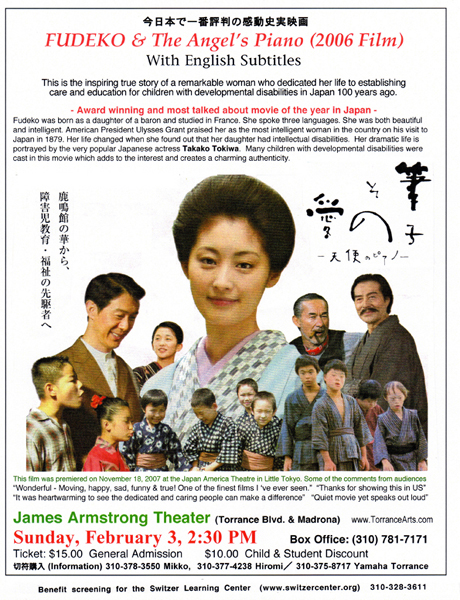
This movie is a dramatization of an historical story about a couple who dedicated their life to children with developmental disabilities over 100 years ago in Japan
when there was no compassion for them.
France and married after she came back in 1884. She was both beautiful & intelligent and played an important role in the Meiji era¹s high society called Rokumeikan.
France and married after she came back in 1884. She was both beautiful & intelligent and played an important role in the Meiji era¹s high society called Rokumeikan.
She was asked to be a teacher at the newly established Women¹s School for Nobility (Kazoku Jogakkou). She taught French. Umeko Tsuda who came back from the
United States after graduating from Bryn Marwr College taught English. Fudeko also pioneered and contributed to the woman¹s rights movement in Japan. However,
her golden age was finished when she gave birth to her first daughter who had developmental l disabilities. She became a Christian baptized by Bishop Williams. She
lost her second daughter as a baby and third daughter also became mentally and physically disabled after serious illness. Furthermore, her husband passed away in
1892. She was running a girl¹s Christian school (Seishu School). She lost her third child and decided to put her first daughter in Takinogawa School before she was sent by the government to the United State with Umeko Tsuda to attend the International Women¹s Club Convention held in Denver, Colorado in 1898.
sent by the government to the United State with Umeko Tsuda to attend the International Women¹s Club Convention held in Denver, Colorado in 1898.
Ryoichi Ishii was born in 1867 as a son of samurai family in Saga prefecture in Kyushu. He studied at Rikkyo Gakuin (St. Paul¹s College. It was founded by Bishop. C.W.
Williams in 1874.) He was influenced by Bishop Williams, became a Christian and was appointed head master of Rikkyo women¹s school. There was a big earthquake
in Nohbi in 1891. Nearly 7,000 people died. He decided to save orphans from this earthquake. He quit Rikkyo and spent all of his money and assets to build a facility to
house and educate orphan girls who otherwise would have been sold. This was the start of Takinogawa School. There were two girls among them who had mental
disabilities. He read a book by Kanzo Uchimura (noted Christian who studied in the United States) and decided to dedicate himself to children with developmental
disabilities. He came to the United States to study the system and method of educating mentaly challenged. In 1897 after he return to Japan, Takinogawa School
became the only and first facility in Japan for children with developmental disabilities.
Fudeko and Ryoichi¹s relationship was kept as colleague and helped each other as educators but their love and respect for each other grow and eventually they got
married in 1903. She gave Seishu School to her best friend Umeko Tsuda and moved to Takinogawa Gakuen to live together with her husband and many children like
her daughter. There was a fire at the facility and lost 6 children. It was a big blow to them. It almost crippled their will but many people including the Empress send
money and encouragement for them to rebuild and continue. Ryoichi passed away in 1937. Although Fudeko had a stroke and became half paralyzed in 1932 she
continued at Takinogawa School as the head of the school until her death of 1944 at the age of 83.
This movie was made in 2006 and is showing now in Japan and received an Award - Jidofukushi Bunka Show by Japanese Ministry of Health and Welfare. The movie
actually used children with disabilities. This is very well received by Japanese audiences. The movie¹s producer and director, Hisako Yamada having a child with
intellectual disabilities herself knows the grief and hope of such parents. Through this movie she hopes to gain understanding and love towards these special children
and she wants people to know of existence of great human being in Japan long ago. This is her wish to be of help in creating a society in which people recognize the
importance of each human being regardless of one¹s disability.
when there was no compassion for them.
France and married after she came back in 1884. She was both beautiful & intelligent and played an important role in the Meiji era¹s high society called Rokumeikan.
France and married after she came back in 1884. She was both beautiful & intelligent and played an important role in the Meiji era¹s high society called Rokumeikan.
She was asked to be a teacher at the newly established Women¹s School for Nobility (Kazoku Jogakkou). She taught French. Umeko Tsuda who came back from the
United States after graduating from Bryn Marwr College taught English. Fudeko also pioneered and contributed to the woman¹s rights movement in Japan. However,
her golden age was finished when she gave birth to her first daughter who had developmental l disabilities. She became a Christian baptized by Bishop Williams. She
lost her second daughter as a baby and third daughter also became mentally and physically disabled after serious illness. Furthermore, her husband passed away in
1892. She was running a girl¹s Christian school (Seishu School). She lost her third child and decided to put her first daughter in Takinogawa School before she was sent by the government to the United State with Umeko Tsuda to attend the International Women¹s Club Convention held in Denver, Colorado in 1898.
sent by the government to the United State with Umeko Tsuda to attend the International Women¹s Club Convention held in Denver, Colorado in 1898.
Ryoichi Ishii was born in 1867 as a son of samurai family in Saga prefecture in Kyushu. He studied at Rikkyo Gakuin (St. Paul¹s College. It was founded by Bishop. C.W.
Williams in 1874.) He was influenced by Bishop Williams, became a Christian and was appointed head master of Rikkyo women¹s school. There was a big earthquake
in Nohbi in 1891. Nearly 7,000 people died. He decided to save orphans from this earthquake. He quit Rikkyo and spent all of his money and assets to build a facility to
house and educate orphan girls who otherwise would have been sold. This was the start of Takinogawa School. There were two girls among them who had mental
disabilities. He read a book by Kanzo Uchimura (noted Christian who studied in the United States) and decided to dedicate himself to children with developmental
disabilities. He came to the United States to study the system and method of educating mentaly challenged. In 1897 after he return to Japan, Takinogawa School
became the only and first facility in Japan for children with developmental disabilities.
Fudeko and Ryoichi¹s relationship was kept as colleague and helped each other as educators but their love and respect for each other grow and eventually they got
married in 1903. She gave Seishu School to her best friend Umeko Tsuda and moved to Takinogawa Gakuen to live together with her husband and many children like
her daughter. There was a fire at the facility and lost 6 children. It was a big blow to them. It almost crippled their will but many people including the Empress send
money and encouragement for them to rebuild and continue. Ryoichi passed away in 1937. Although Fudeko had a stroke and became half paralyzed in 1932 she
continued at Takinogawa School as the head of the school until her death of 1944 at the age of 83.
This movie was made in 2006 and is showing now in Japan and received an Award - Jidofukushi Bunka Show by Japanese Ministry of Health and Welfare. The movie
actually used children with disabilities. This is very well received by Japanese audiences. The movie¹s producer and director, Hisako Yamada having a child with
intellectual disabilities herself knows the grief and hope of such parents. Through this movie she hopes to gain understanding and love towards these special children
and she wants people to know of existence of great human being in Japan long ago. This is her wish to be of help in creating a society in which people recognize the
importance of each human being regardless of one¹s disability.
| Synopsis of Japanese Movie: “FUDEKO & The Angel¹s Piano” |
| World of Asia Pacific & Americas: 002: Special Websites Recommended: 001 Japanese Movie: Fudeko and The Angel’s Piano |



 | |  | |  | |  | |  | |  | |  |
